Key Marco
Waterfront / boating · Gated
Key Marco is its own island off the east side of Marco Island, reached by a bridge and entered past a gatehouse. Addresses are on Blue Hill Creek Drive and Whiskey Creek Drive. There are 134 lots, and what goes on them is detached single-family houses built to order: no condominiums, no villas, nothing attached. Adjoining lots can be combined into one house, so there are fewer houses than lots.
The marina is the point of the place, and the thing most often misread. Its 105 slips are common areas belonging to the association, and nobody owns one, buys one or sells one. What an owner can hold is a license to use one, and that license ends when the house is sold.
Does a boat slip come with the house?
No. The seller's license terminates on the sale of the lot. It passes to the buyer only if three things line up: the buyer asks for it, the boat suits that particular slip, and nobody is on the waiting list for that size and type. Fail one and the slip goes back into the association's pool. The same happens to a buyer who owns no suitable boat and won't within 90 days of closing.
A dockmaster the association appoints licenses the slips, first come, first served, one per lot owned, and a license can't be transferred or assigned.
How big a boat can you keep?
Up to about 38 feet, the top of the association's own slip table. There are 5 piers and 105 numbered slips, and each slip's outer piling sets its size: no part of a boat may stick out past it. The water under the docks is leased from the state, which is why nobody may stay the night aboard a boat moored here, for any purpose. The boat sleeps in the slip. The person doesn't.
A boat can't live at the house either: boats, trailers, jet skis, campers and motor homes may not sit anywhere on the property outside a garage for more than 24 hours.
What else does the marina cost?
Two costs here reach no listing, starting with the lift, which belongs to the owner who installed it rather than to the slip. An incoming licensee who wants to keep it buys it from the outgoing owner at fair market value, a second check separate from the one for the house.
The marina was built in 1994 with a stated life expectancy of 30 to 40 years, and the association puts annual budget money toward capital work on it. Owners with a lift on an original piling are on notice that when the piers are replaced, taking the hardware off and reattaching it falls to them.
What can you build here?
A house of at least 3,000 square feet of air conditioned area, not counting breezeways, porches, patios and garages. Plans go to the architectural review committee twice, preliminary and final, and landscape plans have to run at least 75% native trees and 50% native shrubbery. Clearing the building pad starts a clock, and the house must be substantially complete within 18 months, with no stoppage longer than 30 days. Miss that and the association can remove the unfinished work at the owner's cost.
Some lots carry a recorded archaeological easement, which bars the owner from excavating, digging, building or planting on that ground. Conservation groups hold rights here too. The Conservancy, Inc. can enforce the limits on clearing vegetation on a lot, and the ban on any new dock, overlook or fishing pier outside the development line.
Can you rent the house out?
Narrowly. One lease per calendar year and no more, a 6-month minimum term, nothing longer than a year, no subletting and no assigning. Every lease needs notice to the board and its approval, and the association may charge a processing fee and take a security deposit. Guests in a leased house are capped at 6 people and 30 days, and only while the tenant is there.
Pets are looser: dogs, cats and other non-exotic household pets, with no weight limit and no cap on numbers.
What does an owner pay?
An equal share, whatever the house. The covenants divide the association's whole annual budget by the number of contributing lots and make each owner liable for one share, so a bigger house does not mean a bigger bill.
A buyer also owes a one-off capital assessment at closing, on top of the purchase price. The board fixes the figure, and the covenants cap it at one lot's annual assessment. Special assessments split two ways. One for capital improvements above a set threshold needs a majority vote of the lots. One to repair what already stands on the common areas needs no member vote at all.
- The annual assessment and the capital assessment due at closing, both set by the board.
- Whether a slip that fits your boat is free, and whether a lift in it must be bought.
- Whether the lot carries an archaeological easement, and where it runs.
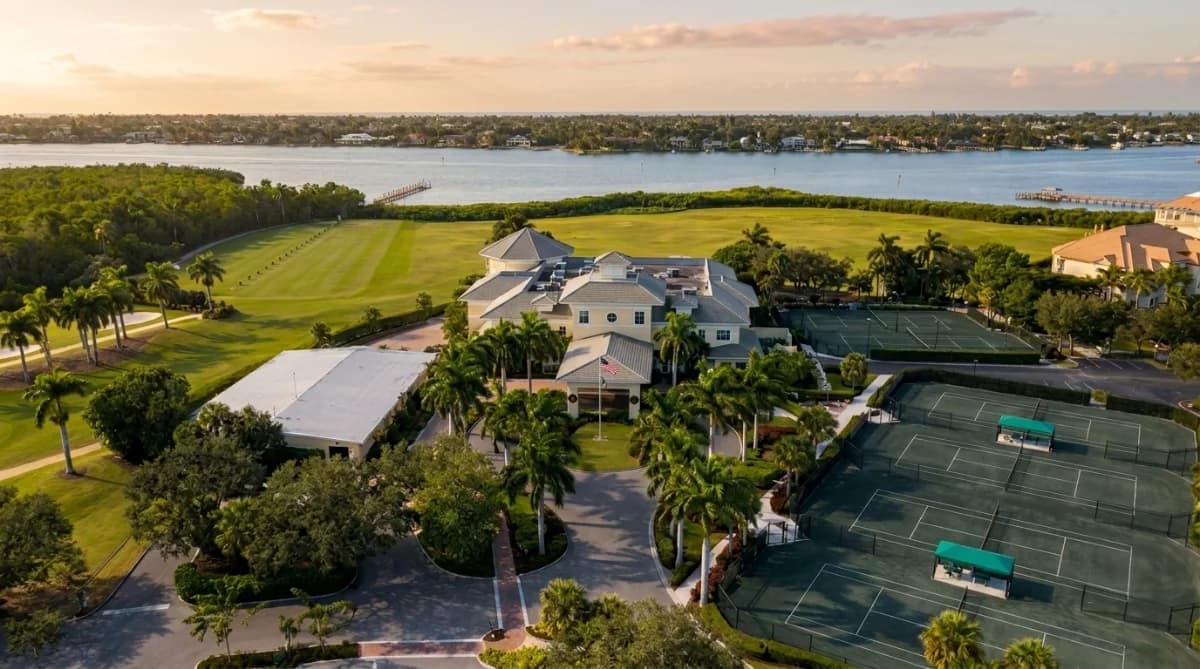
One association covers all of it, and membership isn't a choice. Every owner of a lot joins Key Marco Community Association by accepting the deed, and the lot carries a perpetual easement to use the community's recreational facilities alongside the other owners. No second organization, nothing to buy on top. The community clubhouse stands at 505 Whiskey Creek Drive.
Quick Facts
- Community Type
- Waterfront / boating
- Gated
- Yes
- Residences
- 134 lots; detached single-family houses only
- Location
- Its own island off east Marco Island, reached by a bridge
- Rental Policy
- Annual rentals allowed
- Pet Policy
- Pets allowed (per community rules)
- Marina
- 105 slips licensed, not deeded; boats up to about 38 feet